Entry · Ref 9API1IU6
Website Design for Contractors: What Roofers, HVAC Companies, Plumbers, and Electricians Need for Better Lead Generation
- Posted
- 2026-10-14
- Last amended
- 2026-10-14
- Account
- @poolbuilderguide615
A contractor’s website has one job before anything else: turn local attention into real calls, form submissions, and booked jobs. That sounds obvious, but a surprising number of websites for contractors still act like digital brochures. They look acceptable on a desktop screen, mention a few services, and then quietly lose leads because the phone number is hard to tap, the service area is vague, or the form asks for too much too soon.
For roofers, HVAC companies, plumbers, and electricians, that gap matters. A homeowner with a leak, no heat, a tripped panel, or storm damage is not in browsing mode. They are trying to answer a practical question fast: can this company help me, in my area, and can I trust them enough to call right now? Good contractor website design removes friction from that decision. Poor design adds it.
The strongest home service website design work usually feels simple when you land on it. That simplicity is not accidental. It comes from a lot of careful decisions about page structure, service pages, mobile behavior, local signals, speed, and how the site supports the way homeowners actually search.
Why contractor websites fail to generate enough leads
Most low-performing contractor sites do not fail because they are ugly. They fail because they are unclear.
A roofer’s homepage says “quality craftsmanship” but never makes storm repair, inspections, insurance-related work, or the service area easy to find. An HVAC website design might bury emergency service details three scrolls down. A plumbing website design may ask users to fill out a long contact form when what they really want is a phone number they can tap with one thumb. An electrician website design may list “residential and commercial services” without building separate pages that match what people search for.
That disconnect is expensive. Not always in obvious ways, either. You may still get some calls, enough to think the site is doing fine. But a better lead generation website for contractors tends to capture more of the same demand already in the market because it aligns with search behavior and homeowner urgency.
I have seen this in almost every trade. The contractor feels they need “more traffic,” when the bigger issue is that the existing traffic lands on pages that do not answer basic questions quickly enough. Better traffic helps, but better conversion usually pays off first.
What the homepage actually needs to do
The homepage is not there to tell your whole story. It is there to orient people fast.
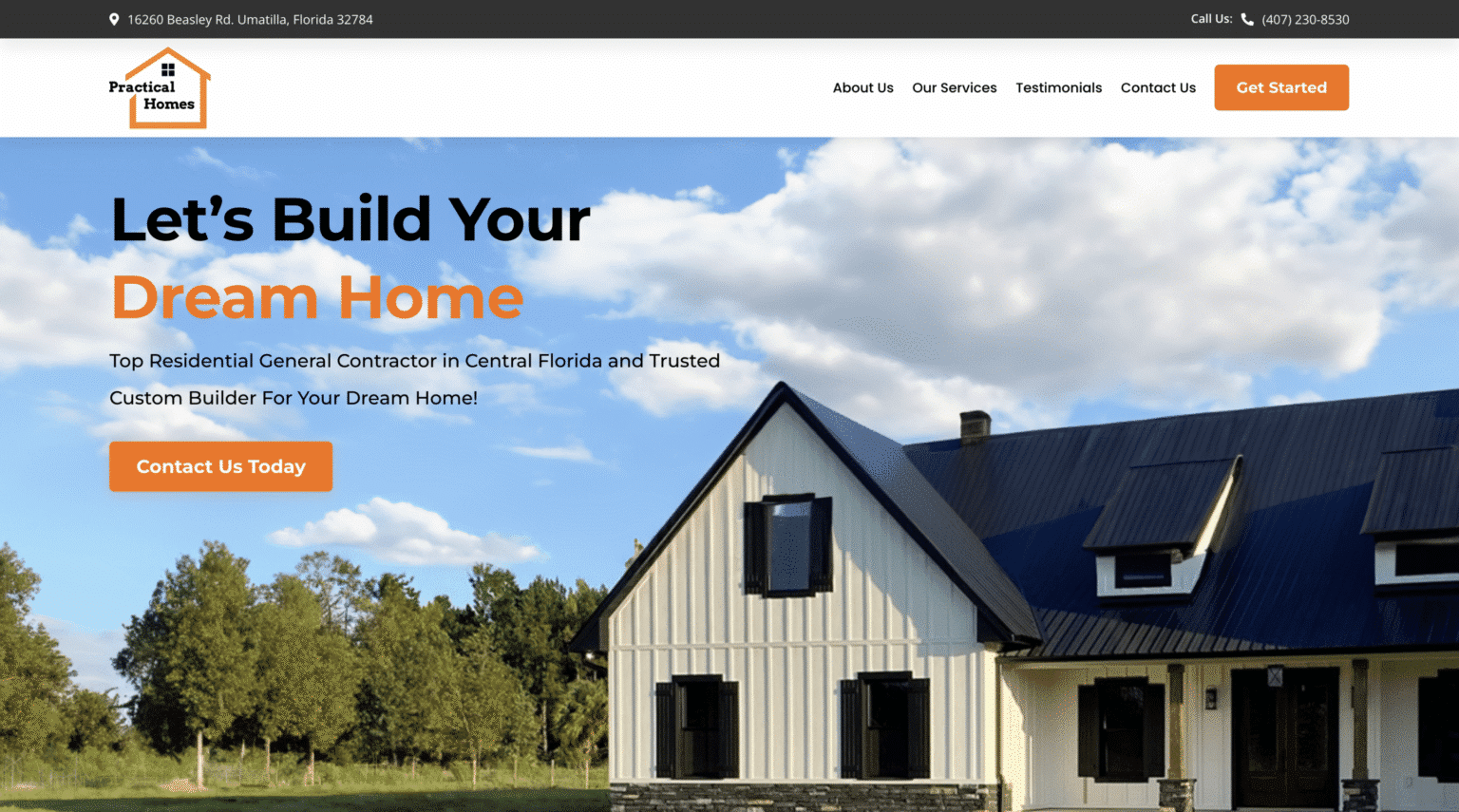
When someone lands on a contractor homepage, they should understand within seconds what you do, where you do it, and what they should do next. That means the top section needs plain language, not slogans. “Roof repair and replacement in [service area]” is more useful than “protecting what matters most.” “Air conditioning repair and installation” beats “comfort you can count on.” Clear beats clever almost every time in contractor web design.
A strong homepage also helps different visitors find their path without making them think too hard. A homeowner with an urgent plumbing issue behaves differently from someone comparing roofing estimates for a replacement next month. One person wants to call now. Another wants to review services, photos, and local credibility first. Good website design for contractors gives both people a fast route.
That usually means visible phone access, a short contact option, a clean route to service pages, and location context that reassures the visitor they are in the right place. Google’s own guidance for local businesses supports clear business information, including contact and location details, so both users and search engines understand the business correctly. For service-area businesses, that local clarity matters even when you do not operate from a public storefront.
Mobile is where many contractor websites win or lose
For home service companies, mobile design is not a secondary version of the site. In many cases, it is the main experience that matters.
A homeowner searching for a plumber from a kitchen floor or an HVAC company during a summer outage is almost certainly on a phone. If the site loads slowly, shifts around while loading, or makes it awkward to submit a form, the lead is at risk. Google’s emphasis on Core Web Vitals reflects real user behavior here. Perceived load speed, responsiveness, and visual stability are not abstract metrics for a contractor. They directly affect whether a stressed homeowner sticks around long enough to contact you.
Forms deserve special attention. On a phone, small usability choices make a real difference. Using the proper phone input field can bring up a mobile-friendly keypad, which makes the form faster to complete. Visible labels matter too. Standard form controls tend to perform better than overdesigned custom widgets that look slick but create friction. If someone wants an estimate or emergency help, the site should not make them work for it.
One practical rule holds up well across trades: ask only for the information you need to start the conversation. Name, phone, service address or area, and a short problem description is often enough for a first touch. Every extra field should justify itself.
Service pages do the heavy lifting
Many contractors put too much pressure on the homepage and not nearly enough on service pages. But service pages are often where lead generation really happens, especially from search.
A roofing website design should not stop at a single “Roofing Services” page. Repair and replacement are different user intents. Storm damage is different from a homeowner planning a full reroof. Inspection-related searches often reflect a different stage of the buying process than replacement searches.
The same pattern shows up in every trade. HVAC website design works better when repair, installation, replacement, and maintenance have room to breathe. Plumbing website design benefits from specific pages for common needs like drain issues, water heater work, or leak-related services if those are core offerings. Electrician website design tends to improve when major service categories are separated instead of being piled onto one generic page.
This is not just an SEO exercise. It is a trust exercise. Specific pages let you speak the customer’s language, explain the problem more clearly, and reduce the chance that a visitor wonders whether you really handle their issue. That confidence gap is where leads are lost.
Local SEO for contractors starts with clarity, not tricks
Local SEO for contractors often gets talked about as if it were a dark art. In practice, the basics are straightforward, even if doing them consistently takes discipline.
Google wants accurate business details across your website and Google presence. For local businesses, clear contact and location information helps search engines understand who you are, where you operate, and when to surface your pages. If you are a service-area business, your public-facing setup may be different from a storefront, but the principle is the same: be precise and consistent.
That consistency extends to your Google Business Profile. Google explicitly supports local businesses with profile features like hours, photos, services, reviews, and service areas. For many contractors, especially plumbers, electricians, and HVAC companies, that profile is not separate from the website strategy. It is part of the same lead generation system. The website builds depth and trust. The profile helps capture local visibility on Search and Maps.
A site that supports local SEO well usually has a believable local footprint. Not stuffed city names, not thin pages built for every suburb under the sun, but real service area information, useful service content, and business details that line up with what appears elsewhere online.
What a lead generation website for contractors should include
The best lead generation websites for contractors usually share a handful of traits. Not because every company should look the same, but because homeowner behavior is pretty consistent across trades.
- A clear value proposition near the top of the page, tied to the trade and service area
- Fast, mobile-friendly contact options, especially tap-to-call and short forms
- Individual service pages written for real customer intent
- Local business details that are accurate and easy to find
- Technical basics such as security, speed, mobile usability, and a sitemap
Those five elements sound simple. They are simple. The challenge is execution. A contractor web design company can add fancy animations and dramatic visuals, but if the site is slow, vague, or hard to use, those touches often hurt more than they help.
The role of trust signals, and where people overdo them
Trust matters in every home service category, but trust signals work best when they support a decision rather than overwhelm it.
Photos help, especially when they feel like they come from the real company rather than a stock library full of smiling actors in spotless uniforms. Consistent business details help. Reviews matter on your Google presence, and the website can support that trust by aligning with the same services and service area customers see elsewhere.
But there is a point where trust elements turn into noise. If every inch of the page is packed with badges, icons, sales bars, and popups, the site starts to feel defensive. Homeowners do not usually need twenty proof points to make a first call. They need enough confidence to believe you are legitimate, local, and responsive.
For roofers, before-and-after project photos can be persuasive, but only if the rest of the page still answers practical questions. For HVAC and plumbing companies, emergency availability is often a stronger trust lever than generic “family-owned” language. For electricians, clarity around residential or commercial focus can prevent confusion and improve lead quality. The point is not to collect every possible trust signal. The point is to choose the ones that reduce hesitation.
Fast, secure, and technically clean still matters
Some contractors hear “technical SEO” and assume it is only relevant for giant websites. It is not. Google’s fundamentals for websites are very practical: be secure, fast, accessible, and usable on all devices. Help Google discover and understand pages through tools like sitemaps and structured data.
Even without diving into code, the business takeaway is clear. A website that performs well technically gives both users and search engines a cleaner experience. Pages load more smoothly. Layouts shift less. Forms work better. Search engines can crawl and interpret the site more reliably.
Accessibility often gets ignored in contractor website design, but it should not. Clear labels on forms, standard controls, readable layouts, and mobile-friendly interactions are not edge-case concerns. They help a broader range of users, and they usually improve conversion for everyone.
Different trades need different messaging, even if the framework is similar
There is no single template that works equally well for all home service website design. The framework may be shared, but the buying behavior changes by trade.
Roofing searches often carry a higher trust threshold because the ticket size is larger and the buying cycle can be longer unless there is storm damage. People may want to inspect photos, compare service types, and read more before calling. Roofing website design should respect that by giving enough detail without turning pages into essays.
HVAC buyers swing between urgency and planning. A no-cool call in July behaves one way. A furnace replacement comparison behaves another. HVAC website design needs to accommodate both, with obvious paths for urgent service and separate pages for installation and replacement research.
Plumbing is frequently urgency-driven. Plumbing website design should reduce delay. The customer often wants certainty that you handle the issue and can respond. Cleaner contact paths usually matter more here than lengthy copy blocks.
Electrician website design benefits from precision. Electrical work can be broad, and users may be unsure whether their issue fits your scope. Service-page specificity helps a lot. So does setting expectations clearly around residential, commercial, or both.
Google Business Profile and Local Services Ads are part of the same system
For many contractors, especially those working in service-area categories, the website should not be planned in isolation from Google’s local products.
A free Business Profile can help a local company appear on Search and Maps, and owners can manage hours, photos, services, reviews, and service areas. That is a real visibility asset for contractors. If your website says one thing about service areas and your profile says another, confusion follows. If your hours differ between platforms, trust drops.
Local Services Ads are also relevant in several home-service categories, including HVAC, plumbing, roofing, and electricians. Google positions them around lead-based interactions such as calls and messages rather than traditional pay-per-click behavior. That has an important implication for website design. Even when leads arrive through a Google-owned experience, the website still influences whether the prospect trusts you enough to move forward. People often check the site after seeing an ad or a profile.
That is why the best lead generation websites for contractors support the full journey. They do not just chase rankings. They reinforce confidence after the first impression happens somewhere else.
Choosing between DIY, freelancers, and a contractor web design company
Small local businesses can do much of their own SEO and website work, and Google’s guidance broadly supports that view. The real question is not whether it is possible. It is whether it fits your time, skill, and growth goals.
A DIY setup can work for an owner who writes clearly, stays organized, and is willing to maintain the site over time. A freelancer can be a strong fit when you need a focused redesign or content support but do not want agency overhead. A contractor web design company may make sense when you need design, technical upkeep, ongoing updates, and someone coordinating the process consistently.
There is also a growing subscription model in the market. One example is a Houston-based provider called Scalable Websites, which offers monthly subscription websites for home-service contractors and includes things like hosting, security, unlimited updates, and a dedicated project manager. If you evaluate any vendor working this way, it is smart to verify current deliverables and claims directly with the company rather than assuming every package includes the same level of support.
The important thing is fit. If a provider talks mostly about flashy design and barely asks about service areas, lead flow, or how calls are handled, that is a warning sign. Good website design for contractors starts with the business model, not the color palette.
Contractor website cost is less about price tags than scope
Contractor website cost is one of the first questions owners ask, and fairly so. The trouble is that “website cost” can mean very different things.
A simple site with a few pages and basic contact functionality is not the same as a lead generation system with trade-specific service pages, local content, technical optimization, ongoing updates, hosting, and security. Some projects are one-time builds. Others are managed monthly. Some include strategy and content. Others are mostly design and setup.
That is why cost should be framed against function. If the site only exists to check a box, the cheapest route may be fine. If the website is expected to support local SEO for contractors, improve mobile conversions, and become a reliable source of leads, the conversation changes. The real cost is not just what you spend on the site. It is what you lose every month if the site underperforms.
A good way to think about budgeting is to ask what the website must do operationally. Does it need ongoing updates? Does someone need to handle hosting and security? Will you be adding service pages over time? Is the site expected to support Local Services Ads or profile traffic by reinforcing trust after the click? Those answers shape the budget more honestly than comparing template prices online.
A practical way to judge whether your current site is helping or hurting
If you want to assess your current contractor website design without getting lost in jargon, use the customer’s point of view. Open the site on your phone, preferably when you are distracted or in a hurry. Then ask yourself a few blunt questions.
- Can I tell within five seconds what this company does and where it works?
- Can I call or contact them without hunting around?
- Does the page for my service feel specific, or generic?
- Does the site load smoothly and stay stable while loading?
- Do the business details feel consistent and trustworthy?
That quick exercise exposes most weak spots. Contractors are often surprised by what they notice once they stop viewing the website as an owner and start viewing it as a homeowner.
The websites that produce better leads usually feel easier, not louder
There is a pattern I keep seeing with websites for contractors that improve lead flow. They are not necessarily the fanciest. They are the easiest to understand and use.
They speak plainly. They match the way people search. They respect mobile behavior. They support local visibility with accurate business details. They make forms and phone calls frictionless. They give each core service enough room to rank, persuade, and convert. They stay technically sound in the background, with security, speed, accessibility, and crawlability handled properly.
That is the real visit the site aim of contractor website design. Not to impress another marketing agency, not to collect trendy visual effects, and not to bury the user under endless content. The goal is to remove doubt at the exact moment a local customer is deciding who to call.
For roofers, HVAC companies, plumbers, and electricians, that kind of website becomes more than a digital brochure. It becomes part of the sales process, part of local SEO, and part of day-to-day lead generation. When it is built well, it does not just look better. It works harder.
About Scalable Websites
Scalable Websites builds professionally designed, AI-powered websites for roofers, HVAC companies, plumbers, electricians, remodelers and other home service contractors, with hosting, security, unlimited updates and lead capture included in one monthly plan.
396 Mallorn Lane, Montgomery, TX 77316
Phone: (832) 979-2478
Website: scalablewebsites.com
About Scalable Websites
Scalable Websites builds professionally designed, AI-powered websites for roofers, HVAC companies, plumbers, electricians, remodelers and other home service contractors, with hosting, security, unlimited updates and lead capture included in one monthly plan.
Houston, TX · Serving contractors nationwide
Phone: (832) 979-2478
Website: scalablewebsites.com